Getting Away From Machines
Marguerite Galizia | OCT 24, 2021
pilates
exercise
somatic
movement
history of exercise
Getting Away From Machines
Marguerite Galizia | OCT 24, 2021
When I first started teaching Pilates, most of my work involved teaching Matwork classes in Gyms. For many people, these classes were their first encounter with Pilates, and I noted their reactions to the work with some interest. There were often comparisons to keep fit classes which appear to be more ‘active’. Pilates, it was thought, is more of a relaxation, lying on your back and stretching ‘sort of thing’. They couldn’t quite place it in terms of what they normally considered to be ‘exercise’. But, despite its appearance of being more restful, they were surprised by how hard they worked, how precise the movement direction was and how accessible and appropriate the material was for their needs.
Pilates has benefited greatly from its accessibility, (ie: the fact that it offers movements that people can generally do, as opposed to movements that most people find beyond their ability). This has made it more easily incorporated into the fitness industry. Its functional and anatomical approach has led to its use in rehabilitative exercise programmes. If you visit a GP or physio with back pain, there’s a fair chance you’ll be told to join a Pilates class. But whilst this accessibility is welcomed, it leads to some challenges for teachers, particularly in managing fitness related expectations and misconceptions about how the practice actually “works”. I think that the main reason for this discomfort is the tendency of the ‘fitness approach' to reduce everything down to ‘exercise: the choreography of body based movements whose aim is to load muscles in order to strengthen, and stretch muscles in order to lengthen them. The emphasis on goal driven activities, an obsession with body image and the countless distractions that entertain people during these activities, often lead to a kind of mindless state, where the brain zones out whilst the body-as-machine is toned and stretched from the outside.
I’ve recently been interested in the evolution of what we now describe as exercise. Historically, exercise was associated with military activity. Susan Leigh Foster notes that ‘Upper class men exercised in fencing, horseback riding, and hunting as a way of acquiring skills necessary for going to battle.’ (Foster, 2010). Foucault has described the emergence of military exercise as a means of controlling individuals, (rather than empowering them), through top down methods of ‘instruction’ that allowed state to ‘have a hold over others’ bodies, not only so that they may do what one wishes, but so they may operate as one wishes, with the techniques, the speed and the efficiency that one determines’ (Foucault, 1977). The association with military training persists in fitness training today, and is often actively entertained with ‘military boot camp’ style classes. No doubt, the intention of these sessions, and indeed of the entire fitness industry, is to motivate people to move for fitness, and in that respect this is a good thing. But I think it’s important to recall that, when we embrace these associations, ultimately we are talking about the exercise of power via the body, with all of the more sinister, political implications of this.
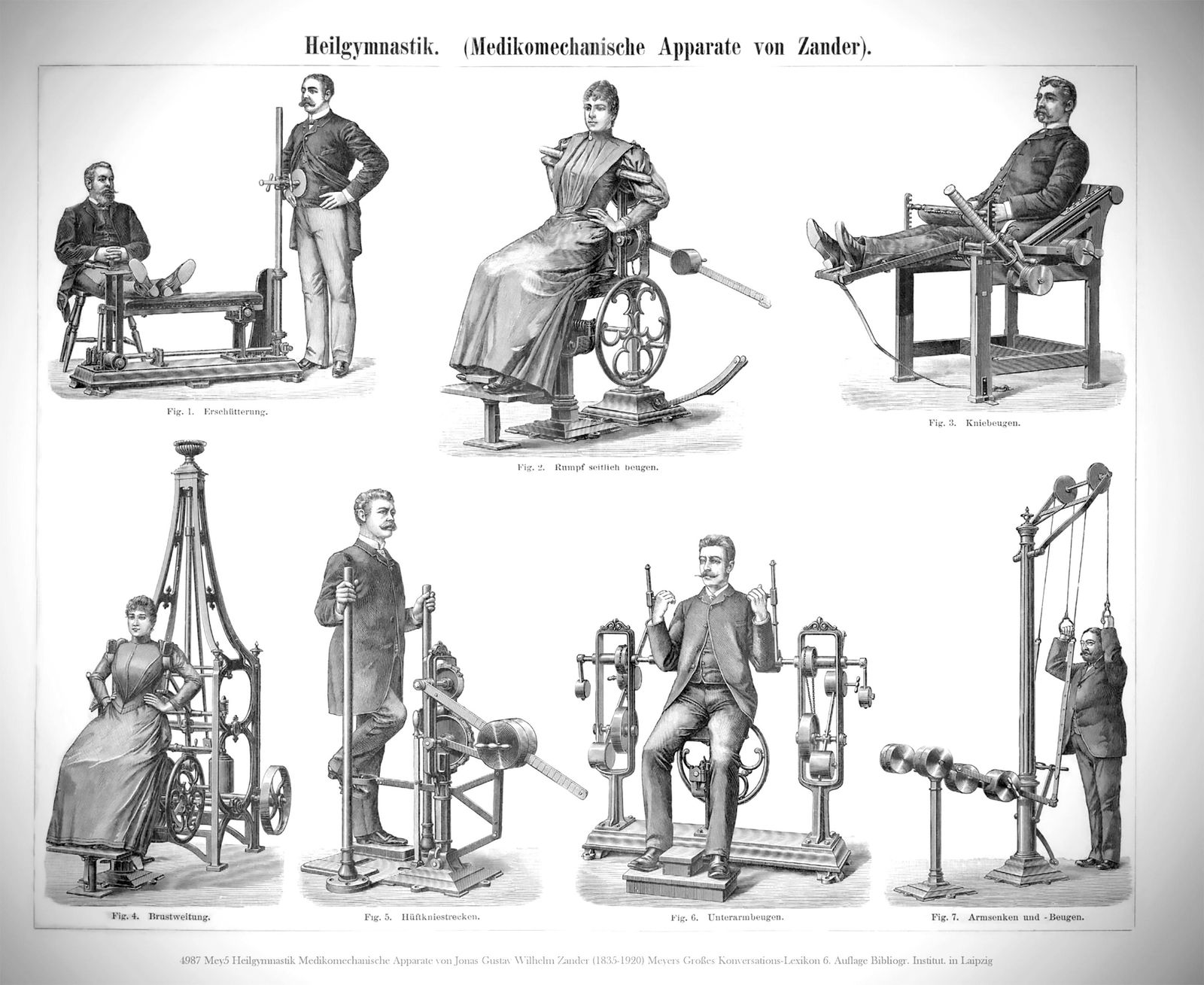
The industrialisation brought about a shift in emphasis. The differentiation of muscle groups and the development of machines, coupled with a recognition of the importance of exercise for general health and wellbeing in urban life, led to a new interest in mechanised movement. By the early twentieth century each muscle group could be accessed separately by the use of specifically designed machines. The Swedish physician Gustav Zander, noting that muscles required resistance in order to be strengthened, developed a series of machines for this purpose. Dudley Allen Sargent’s exercise machines became a staple in YMCA centres across the US. These machines closely resemble those found in modern gyms and with them are the underlying attitudes towards the body that led to these inventions: the anatomization of the body into separate parts, the close association of body with/as machine and the use of exercise as a means of ‘taming’ young men.
I cannot help but note that Pilates, with its emphasis on external equipment, certainly fits in with this relationship between body and machine and the anatomized approach to the musculo-skeletal system. It is no surprise that the Reformer is becoming a staple in gyms and group classes, sustaining the Pilates world’s uncomfortable alliance with the fitness industry. I hasten to add that it is not my aim to completely discredit this alliance. There’s a tricky balance that Pilates teachers play between making our work accessible and maintaining its rigour, and the Pilates-in-gyms scenario is on the front line of this negotiation. But I do take issue with the reductive tendencies of these scenarios, because Pilates is not simply a system of strengthening and stretching exercises, it’s an approach to movement and overall health that underpins a large and ever evolving repertoire of movements and practices.
As Eve Gentry famously noted ‘We don’t teach exercises, we teach concepts’. Over the years, these ‘concepts’ evolved into a series of Pilates Principles that aim to capture this elusive ‘approach’. These principles are: Breath, Centering, Control, Concentration, Precision and Flow. My sense is that they aim to articulate an approach to movement practice that is about bringing the individual into their body in a mindful way, and it is these principles that define Pilates as a somatic practice. The word ‘somatics’ was coined by Thomas Hanna to describe the emerging body of work that considered embodiment from a first person perspective as opposed to the external perspective. Somatics involve techniques in which the mover is led from within their own movement. It includes practices like Body Mind Centering, Rolfing, Feldenkrais, Authentic Movement, Alexander Technique, Bartenieff Fundamentals, amongst others. These bottom up approaches involve the use of different movement protocols that call on the participant to consider their own sense of themselves from the inside out. This is not to say that there is no direction from the teacher or bodyworker, there absolutely is, but the focus is not on the external outcome of the work, but rather on the inner working itself. Writing in the introduction to Bone Breath and Gesture, Don Hanlon Johnson explains:
… [Somatics] have challenged the dominant models of exercise, manipulation, and self-awareness that alienate people from their bodies. They have developed alternative ways of moving, touching and being aware that brings us closer to the wisdom inherent in the ancient structures of collagen, nerve fibre, and cerebrospinal fluid…’ (1995).
The interesting thing to note here is that Pilates is often not considered to be a Somatic practice. This blog post has tried to point out some of these reasons: the tricky relationship that the technique has with the fitness industry; Its appearance as a linear system of movements that involve ‘corrective’ principles, where correction is often offered from a third person, rather than first person perspective (a point I will pick up in my next blog post); The use of machines and equipment as a means of accessing muscular engagement. All of these are reasons that might disqualify Pilates from the somatic label. In the next few blog posts I’ll be unpicking this further and offering thoughts on how the somatic approach underlies my own (and many other Pilates teacher’s) approach to the method. For now, I want to make the case for why this is an important classification.
To refer back to Hanlon Johnson’s argument, the emergence of Somatics in the twentieth century was a response to the violence of war that defined the times. Key to this was the development of machines of war that inflicted horrific injuries and enabled mass extinction of people. As he notes:
To clean up such an atmosphere we need a strong public voice on behalf of the sensitivity of flesh, the sacredness of nature, the importance of health and affection over religious and political ideologies and over stark greed.
I feel that it becomes so easy to get carried away with muscles and outcomes and to forget about the individual. It becomes easy to get caught up in the latest gadgets and machines and forget about the contexts that brought them about, to unquestioningly sign up for that ‘violence’ no matter how innocuous it might seem. To me, the need to step away from the machine, to consider the ‘concepts’ that Eve Gentry alluded to, is not only a question of definition but an ethical one too.
References:
Foster, S. (2010) Choreographing Empathy : Kinesthesia in Performance. London: Taylor & Francis Group.
Foucault, M. (1977) Discipline and Punish, the birth of the prison. London: Penguin Books.
Don Hanlon, J. (1995) Bone, breath and gesture. Berkeley: North Atlantic Books.
Marguerite Galizia | OCT 24, 2021
Share this blog post
 OfferingTree