Moving from the Hip
Marguerite Galizia | APR 6, 2022
hip movement
lower back pain
pilates
Moving from the Hip
Marguerite Galizia | APR 6, 2022
Pilates has long been thought of as an effective 'treatment' for lower back pain. The most commonly cited reason, or even motivation, for someone to join a class in the first place, is back pain. Often clients rock up in a class after being told that Pilates is good for 'core stability'. They've been told that they need to 'strengthen their core' and so, here they are.
I don't want to completely discount the importance of 'stability', although I think that the over-emphasis on 'core work', which is so often taken to mean 'lying on your back with your legs in the air and attempting to pull your head to your knees' (or something similar), is reductive and over-simplified, to say the least.
In fact, I rarely start with this version of so called 'core-stability', and this is because the primary* reason for lower back pain is the over-flexion (bending) of the lower back, which is largely due to an un-differentiated hip joint.
(*I hasten to add, that rotation is another key factor, but it is often coupled with and exacerbated by flexion)
Sitting, (for example), is mostly detrimental because it encourages us to hang out in our lower backs, using the lower back like a hammock as we tire and slouch. And for those of us who do spend time sitting up on our sitting bones, the tendency to grip in our hip flexors creates another problem as it shortens the front of the hip leading to an anteriorly tilted pelvis that pulls the lower back into a compressive arched position.
If there was one thing that everyone could benefit from, it's the ability to 'locate' and 'differentiate' their hip joint from their lower back.
Take a moment right now to notice how you're sitting or standing as you read this.
Where are your hip joints?
Even for someone with years of movement experience, locating my hip joints in a static position is almost impossible. What happens to me when I hear this question is an instant desire to move around so that I can sense where my hip joints might be through that movement.
Even our language is confusing. The phrase 'hands on hips' often refers to placing the hands on the large ear-like pelvic bones that we can palpate on either side of the pelvis. Anatomically, these are the illiac crests... not the hip joint.
And when you get measured up for a new pair of trousers, the phrase 'widest part of the hips' often refers to the points on the outside of the top-most part of the legs, anatomically the greater trochanters... not the hip joint.
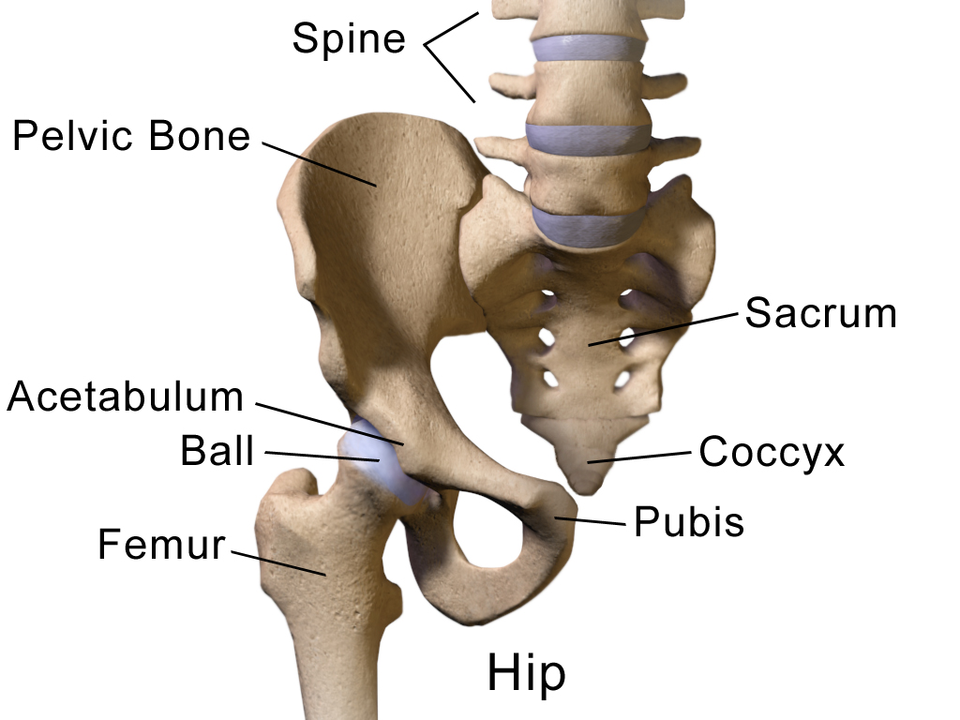
The hip joints are quite deep inside the pelvis, and comprise of the socket (acetabulum) which is built into the bones of the pelvis, and the head of the thigh bones (femoral heads) which protrude inwards from the long bone of the thigh (femur) via the neck of the thigh bone. There are several variations in the angle of both the neck of the femur and the orientation of the acetabulum which leads to structural limitations or capabilities for movement.
The head of the thigh bone is held in the socket via a number of strong ligaments, and reinforced by a number of muscles that cross from the pelvis to the thigh bone and lower leg. This structural and functional stability is helpful since it gives us the ability to walk (an inherently unstable activity). At the same time it makes the hip particularly vulnerable to the pull of the leg muscles. Tight calve muscles, for example, can hold someone in a swayed back posture, reducing their ability to flex around the hip joint.
Tightness down the legs restricts our ability to isolate the movement of the pelvis around the head of the thigh bone, or the movement of the thigh bone within the socket, both of which are necessary for hip joint differentiation. As a result, clients who show up with postural deviations in the hip joint, are rarely able to 'move from the hip', calling on their lower backs instead to affect hip flexion or extension. Add to this the invariable torque caused by even a slight asymmetry, load this with everyday life and a good dose of sitting at a computer, and viola there's your back pain.
Of course I would be falling into my own trap of 'being reductive and over-simplistic' if I was to suggest that this alone could 'cure' all lower back pain. The picture is rarely so simple. And strength around the entire core-capsule (including the multifidus up the back and the corset-like TVA around the centre) is important for spinal stability. What I want to get across here is that often to most effective way-in to addressing lower back pain, is to focus on hip mobility instead. It takes the emphasis off the lower back and reduces unnecessary strain in the area by bringing more awareness lower down the chain.
Marguerite Galizia | APR 6, 2022
Share this blog post
 OfferingTree