The Pros and Cons of Online Pilates Teaching & Learning
Marguerite Galizia | JAN 3, 2022
online pilates
The Pros and Cons of Online Pilates Teaching & Learning
Marguerite Galizia | JAN 3, 2022
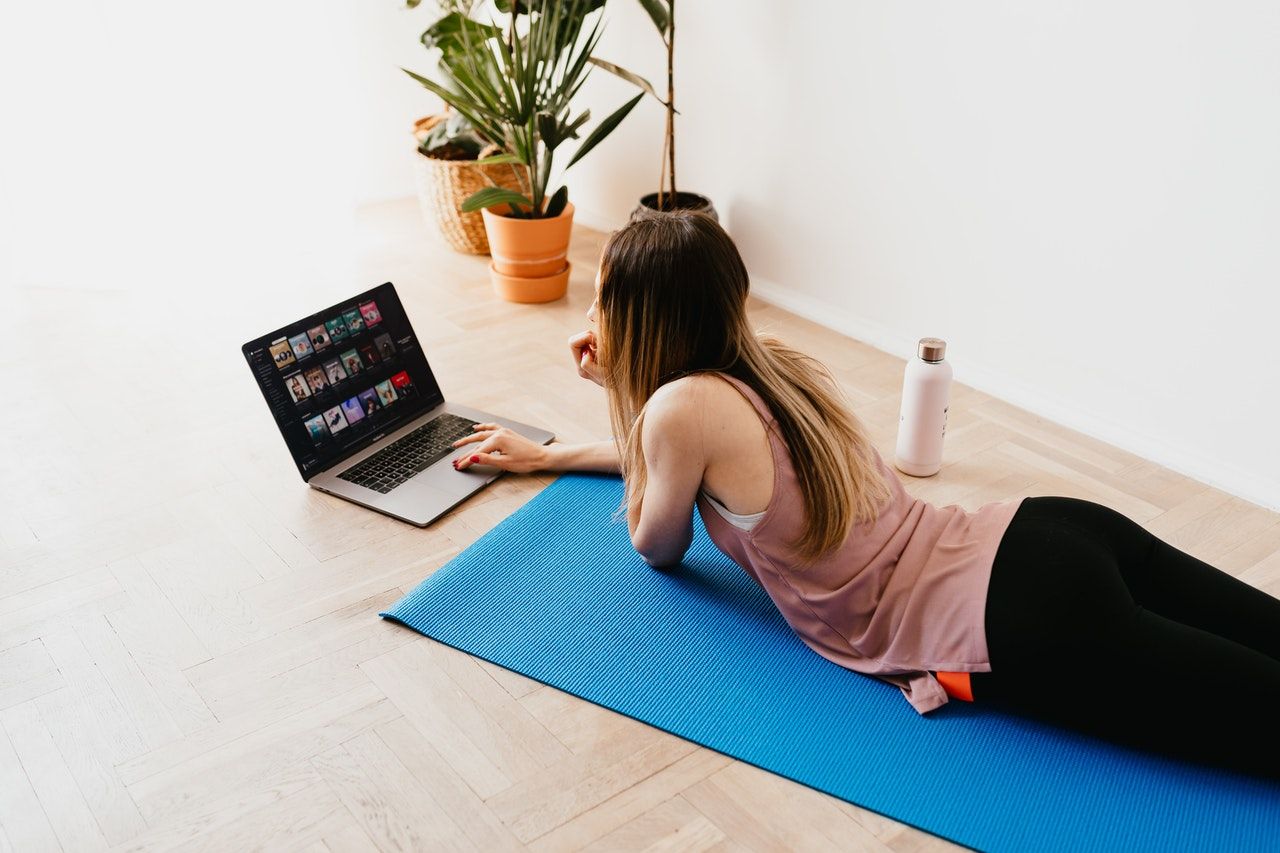
As far as Christmases go, this year has been one of the most miserable. A day after teaching my final class for the year, my husband tested positive for covid. Cue: the entire holiday period spent sniffling into tissues and watching increasingly rubbish TV. Unfortunately I’m not quite out of the woods yet (thank you sinuses), which would normally be a cause for panic as the end of the holidays draws near. In normal times I’d start fretting about teaching clients feeling as though my face is about to explode. The one saving grace is knowing that, since most of my teaching is still online, I’ll be able to ease into it slowly, from the comfort of my home, without worrying about passing anything on to my clients.
In fact the necessity to shift all my teaching online during the pandemic has massively increased my quality of life. I no longer spend half my day on tubes and buses getting from client to class to client etc. I don’t have to waste money in cafes just to sit somewhere warm and out of the rain whilst I wait out the hour between one session and the next. My teaching time is more condensed and efficient, so I have more time for my own practice, training and PhD research. This doesn’t mean that I’m less committed to my work. By cutting out all the distractions and difficulties of navigating the nomadic freelance life, I feel that the quality of my teaching has improved. I get to take classes with my favourite teachers all over the world, without having to leave my home, which gives me access to new ways of thinking and approaching movement. Likewise, I get to teach clients all over the UK and Europe, reconnecting with people I used to teach and who have now relocated, or live too far away to take in-person classes with me. As both a movement teacher and student I have found the shift online to have massive benefits, which is why I was surprised by the eagerness to ‘get back to normal’ since the relaxing of lockdown measures.
With covid numbers climbing off the scales, the start to the year looks pretty uncertain. In the short term at least, online classes are going to remain a necessity for most of us (certainly for me if my sinuses have anything to do with it!). So I wanted to take a moment to consider the pros and cons of online Pilates teaching/ learning before we launch into another term. My thoughts below are drawn from both my experience of teaching and of being a student of other teachers, so I’ve tried to consider both perspectives. Whilst I’m clearly in favour of online teaching, I am aware that this is not some people’s preferred format, so I’m not suggesting any ‘right-ness’ or ‘wrong-ness’ here. I agree that we cannot go exclusively online and there are situations where in-person teaching is not only preferable but essential. I am also aware that I write from the privileged position of not running a location based business, ie: a studio, and so I do not have the ongoing costs of a studio space to consider. My intention here is not to fight the for or against battle. But what I do want to do is challenge some of the misconceptions and expectations that, I think, wrongly lead people to decide that online doesn’t work, and to make some recommendations that might help us all get the most out of it, whilst it remains necessary.
This comes top of the list for obvious reasons. With an online class we all save time on commutes to and from the location. And, as I pointed out above, this is not simply about making schedules more efficient, it leaves more time for other things in life, like spending the evening with friends and family or getting an extra hour’s sleep. Ofcourse, there is a downside to this which is that we all get less enforced movement (no need to run for a train, or climb those escalators), which is why it’s more important to prioritise opportunities for good quality movement.
Without the need to pay for studio space, online classes offer a real opportunity for us to make our work more accessible. Many teachers now offer classes on a donation basis, which allows people to join classes that might not have been accessible to them financially. Online classes are more accessible simply by not being limited to location and by feeling less threatening for individuals who might otherwise feel they were out of place in an in-person class.
One of the most rewarding initiatives I took on early on in the pandemic was to set up a chair-based class. I have 8 regular attendees spread across the UK (and one in Malta) who show up every week and chat to me and to each other before and after the session. None of them knew each other before, but we now have a great little community and a real sense of working at something.
There is no doubt that teaching online has changed my teaching. In an online scenario I find I can be more deliberate in planning the content and structure of classes as well as the arc of a course of classes. This is partly because I cannot respond as easily to individual demands/ concerns, which might be considered a Con, but I have found to be quite liberating. Rather than teaching 10 individuals simultaneously, I now feel I teach a group of people at a time, which is a far more realistic option. I set the level of the class, adjust my content based on the needs of the group, but then I steer the group as a whole through the arc of the work. I feel I have more opportunity to really teach, rather than resorting to hands on correction that can sometimes be quite a blunt tool. I find myself using a more varied vocabulary and imagery to help my classes and clients sense into the work. The result is that (I hope) I’m giving clients more responsibility for their own practice, which is always the way it should be.
This is an important question and to be honest I’ve witnessed many occasions where precautions have not been adequate to ensure the safety of all participants. I often join classes where I am never asked to complete an online PARQ, where the only screening is a teacher asking clients to send them a chat message about any injuries at the start of a class. This is obviously better than nothing, but I’d argue that it is not adequate for screening other medical conditions (such as high/low blood pressure, recent surgeries, Osteoporosis, DR’s etc) that are more prevalent than people expect. However, the downside to online forms is that clients sometimes complete them in a rush and leave details out. Therefore, for your own safety, make sure you are attending a class with a qualified instructor and take your time to complete the online health form correctly. Other safety factors include ensuring you are warm enough and that you have the correct clothing and equipment for the class. If in doubt, you should always ask, which you can do via email before the class or a private chat message during a zoom session.
I want to distinguish this from the previous question because I think they can easily be conflated. There are situations where a movement, or set of movements, can be un-safe for an individual. An extreme example would be asking a group of beginners to do a handstand in their homes, when the teacher cannot possibly be there to support them. That would not be safe. However, the question of whether or not you’re ‘doing it correctly’ is another matter and one that I’d like to challenge.
The problem with the statement is the notion of ‘right’ and ‘wrong’ itself. What does it mean to do an exercise incorrectly? Have you got the choreography wrong? Or have you got the technique wrong? If it’s the former, then it doesn’t really matter. If it’s the latter then it’s possible that this could cause problems, and, yes, I might not realise that you’re doing this during a class. However, as I have long argued, learning and teaching are always a conversation. You can never (not even in an in-person class) expect a teacher to know whether what you’re doing is absolutely right or wrong for you. That is because everyone’s different. What is essential is that you communicate how things feel. I appreciate that this may be tricky in a class situation, however, if you experience any discomfort during a class, you absolutely can interrupt the class and ask about it. Or, you can stop what you’re doing and ask me at the end of the session.
In my experience over the last 18 months, this has mainly been a problem with newcomers to the technique who are not yet familiar with it and who therefore are more likely to make assumptions about what they ‘should’ (another problematic word) be feeling. The bottom line is that there is no question too silly to ask. The chances are that in a group of 10 other people at least 3 will be wondering what they ‘should’ be feeling. So just un-mute and ask.
The physical presence of a teacher and other group participants can provide additional motivation and focus during a class. I know I sometimes find it hard to concentrate when other things are going on around me, or I can hear my husband on a phonecall upstairs. I notice that when my camera is off I feel particularly disconnected. My advice is to always work with your camera on, even if the teacher cannot see all of you. It just gives you that little nudge of accountability that we all need. However, I also feel, that it’s quite useful to be in your own space. I find I’m less likely to be competitive and I don’t worry so much about getting things right or even (sometimes) doing my own thing when a move doesn’t feel right. Constantly walking off and doing other chores during a class is distracting both for you and for the teacher, but having a little more autonomy over your practice, choosing to sit out of things for example, is a good thing.
This is the hardest point for many people to get their head around. Finding the space in your home, setting up the laptop so that you can see me and I can see you, getting zoom to work, dealing with dodgy wifi. All of these can be annoying, however, for the most part, they get sorted out in the first few weeks and then most people settle into some kind of a system.
The truth is, there's always going to be something that's 'not quite ideal' about any endeavour that requires our engagement. If there's one thing that I've learned in the last 18 months, it's how wonderful we are are at finding good reasons that convince us that we cannot possibly do things. So, as we enter a new year, here's my little nudge to those of you who have been putting things off: There was never a time when classes were available so widely, and with so much flexibility and convenience, and there was never a time when our general lack of movement made these classes as necessary as they are today. My resolution for this year is not just to move more, but to get out of my own way.
My recommendations for safe practice are:
See you on the mat!
Marguerite Galizia | JAN 3, 2022
Share this blog post
 OfferingTree