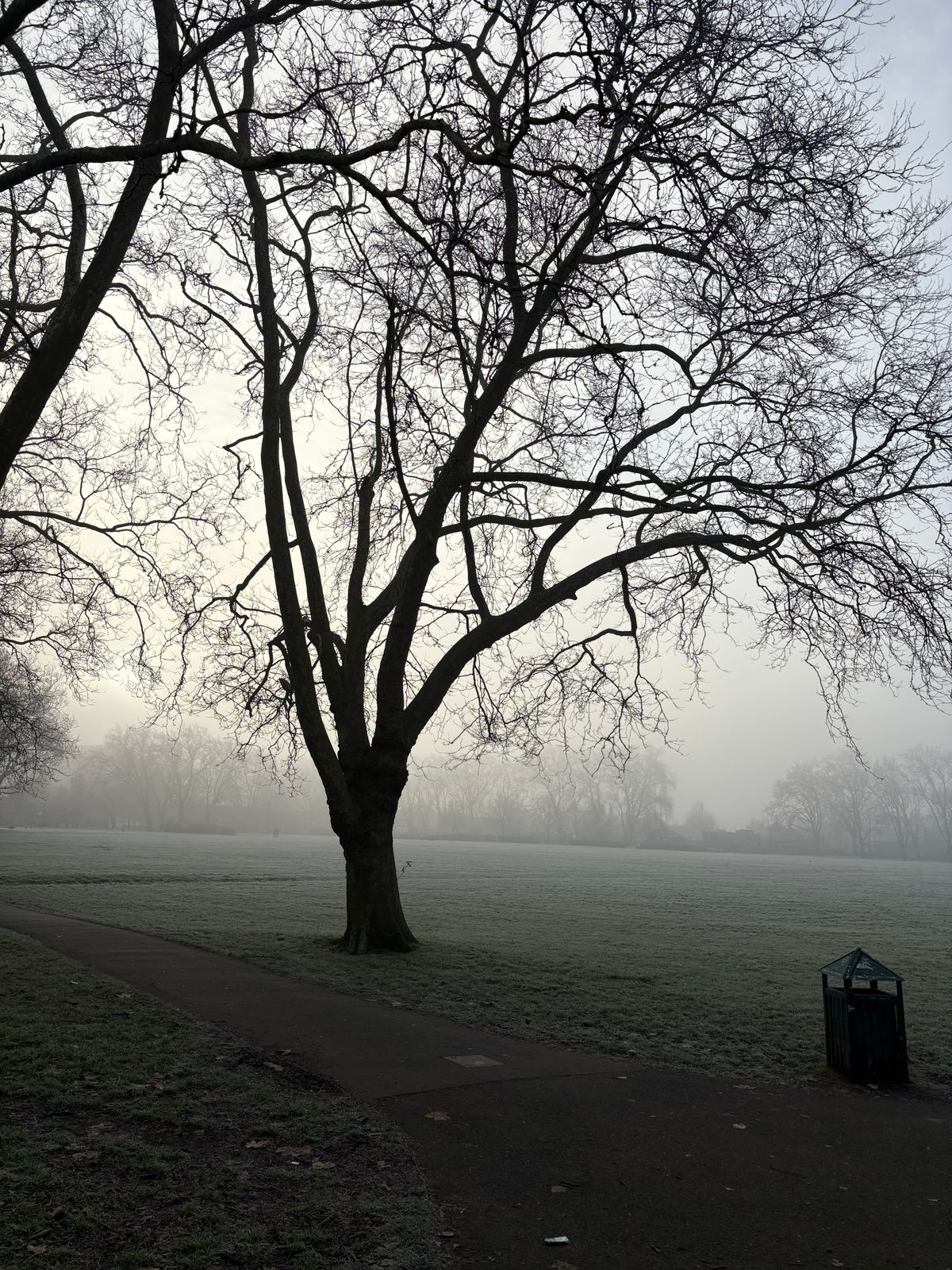
Wintering in my local Chestnuts Park - January 2025
To get me through this winter's freeze, I've been reading Katherine May's book 'Wintering' - the book of the season, describing 'winter' as a metaphor for life's 'fallow periods'. May writes:
"We have seasons when we flourish and seasons when the leaves fall from us, revealing our bare bones. Given time, they grow again.”
As someone who's experienced many of my own winters, I don't want to minimise the challenges it brings. But I did have some thoughts about how May's 'wintering' might be reflected in a movement-based practice like Pilates.
I'm intrigued by the 'bare bones' of wintering. It feels like a chance to meet the ground, to yield more deeply, to exhale. In my classes this term I've found myself tending more to this sense of 'meeting the ground'. During centering sessions, I focused on the softening of the body's core, to access the Deep Front Line of the body. During breath-focused classes, we sought out the 'deeping' at the end of the out-breath (countered by a sense of suspension at the top of the in-breath). We've opened our feet into the ground using tennis balls to release the tension in the plantar-fascia, and we spoke about releasing the arms into the shoulder socket to let go of the upward lifting of shoulders-t0-ears that is such a natural response to the cold.
In my non-teaching life I decided to allow the cold in, rather than tightening up against it. When I went for walks I noticed that tightening only cut off my circulation more. When I went for runs, feeling the cold prompted me to run faster.
I noticed how the cold affected me in my teaching. There was one week where the studio I work in was particularly chilly. So much so that someone fell ill, prompting me to send out emails to various parties to get the temperature changed. I've no idea whether anything was actually actioned, but a week later, everyone walked in and said it felt 'much better'. My sense is that our perception of cold changes as we acclimatise to it. That said... I won't be jumping into a cold sea anytime soon!
We have a habit of thinking of time as a linear progression, just as we might think that learning is a journey from A to B to C etc. Whilst it's true in some senses, it's also more nuanced then that. Learning, like time, like the body and movement in general, has its cycles. Having taught Pilates for 18 years now, I've witnessed many of my clients' cyclical journeys. It's never a case of just getting the exercises right or getting better at them. What we do is learn a technique and then apply that technique to each day/ each practice / each class. The repetition of practice is never a real repetition, because by the time we cycle back again we're always somewhere else.
May's book doesn't conclude with any grand gestures. There's no way to avoid winter. But perhaps there is a way to re-frame it. She writes: “Winter is not the death of the life cycle, but its crucible.” There's some deep wisdom in that, I think.
 OfferingTree